
|
July, 2012 Update from Family Garden TrainsTM
Note: This is the web version of a newsletter from the Family Garden TrainsTM web site, which publishes information about running big model trains in your garden as a family activity.
If you are not subscribed to the Family Garden Trains newsletter, and you would like to subscribe, please join our Mailing List, and specify that you want to receive e-mail updates.
Also, if you would like to subscribe to our free newsletter for indoor railroads and seasonal display villages, please join the "Trains-N-TownsTM mailing list. You can subscribe to either, both, or neither, and we will just be glad to be of service, no matter what you decide.
Fine Print: If you are receiving our e-mail updates and you no longer wish to subscribe, please e-mail me with a "Please Unsubscribe" message (worded any way you wish), and we will graciously remove you from our list.
In this Issue
If it seems that you haven't gotten a newsletter for months, that's because you haven't. Ironically, part of the "problem" is that we've been busy growing! Just not so you can see. Our blog-like article A Peek Behind the Scenes should fill in the gaps.
In the meantime, a two-week trip to Ireland to visit a daughter studying there gave us lots of chances to try, photograph, and report on new and ancient aspects of railroading in western Ireland. This month, we report on that trip, as well as a unique tribute to Irish railroading that is being set up in the small city of Bray.
When we got back, in mid-May, we learned that a record-setting hot spell had advanced the weed-and-groundcover growing season by about four weeks. So quite a bit of cleanup was required before I could even see the garden. And several subsequent weeks in the 95-105 temperature range have slowed down work as well. That said, when the sun dips below the maples, finally throwing a bit of shade on the back yard, it's nice to sit and watch the waterfall run and the building lights come on, even though the track needs service and most of the trains are still in their crates. It's a reminder that an attractive water, perennial, rock, and confier garden (with a lighted building here and there) is a pleasure 365 days a year, even if there aren't trains running at any given time.
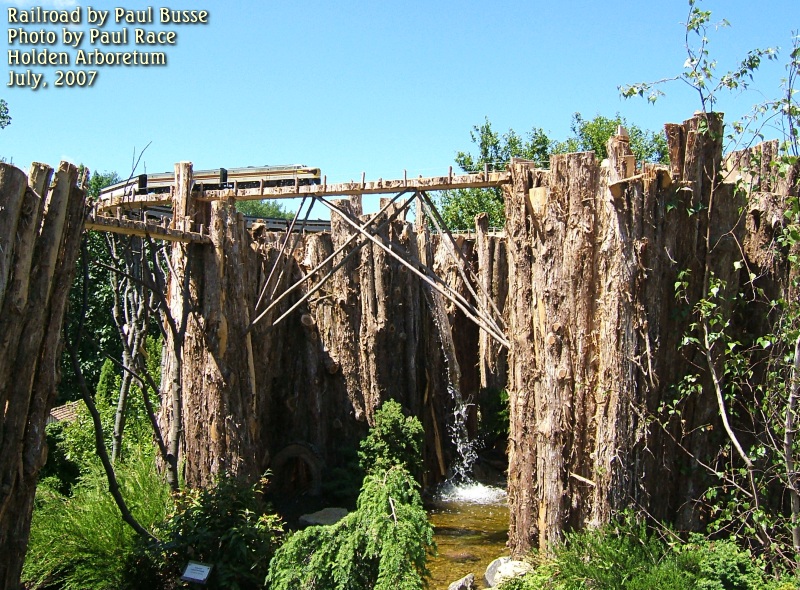
As of this writing, some of our readers folks are experiencing an "economic recovery" and some folks aren't. Strangely enough, some would-be garden railroders who have been waiting to invest in a "starter set" for their garden railroad are learning now that several popular sets are all but unavailable - even if you have the money. But if you want to devote your attention to your "garden" part of your garden railroad, you'll learn that planning, creativity, and hard work don't have to be expensive. And they can make a world of difference in your garden, as well as any railroad you're planning to build or upgrade. You'll find a bunch of ideas in the following article:
Here's an irony, while I've been thinking about gardens and plantings and water features, three of our features this month involve structures. Maybe it's a "sign." At any rate, we have a bunch of other articles in the works, including more structure articles, so stay tuned.
Finally, please accept our wishes for a great rest of the garden railroading season. And please especially enjoy any time you can spend with your family in these days.
Topics discussed in this update include:
A little-known rural hobby seems to have preceded the "structures" part of modern garden railroading by over a century. Folks used to build home-made wooden houses to decorate the property. Often the houses were "models" of the farmhouse itself, and even used the same shingle material. A few were outdoor dollhouses or mailboxes, but many were just for show. Unknown amateur craftsmen, just for the fun of it, built charming structures that in many cases, have lasted decades longer than the average plastic building left outside. They also showed that structures can be great garden decorations, all by themselves.
To see the article and lots of photos, please click the link below.
Over the last few years, Garden Railways magazine has moved more and more of its resources online for subscribers. Once in a while they will make material available to folks who don't subscribe, just to give you some idea of what you're missing. This is one of those times. Detailed drawings of a small "branch-line" station are available to download free. (You have to register on the site, but the registration is free.)
By the way, if you're not subscribing to Garden Railways, you should. We target beginning and intermediate garden railroaders, but they have articles for all levels, including many photos that will encourage and inspire you. They also have about four times as many writers as we do, so they can automatically generate more articles than we can. True, a subscription costs more than our free newsletter, but it costs a lot less than, say, a building, a car, or even certain figures. So if subscribing to Garden Railways can help you at all with your railroad, it will almost certainly pay for itself quickly.
We want to keep you on our list, too, of course, but as you know, we have a different approach and try hard not to overlap.
To see the plans, please click the link below.
- Kalmbach has published another collection of Jack Verducci's most popular articles, this time focusing on Jacks tips for building, installing, and maintaining garden railroad structures. Though it's not a step-by-step "how-to" instruction manual, it's guaranteed to give you some great ideas. Not to mention that it's easier to take around with you than a web page, and makes a great gift, hint, hint.
To see the book review, please click the link below.
Three members of the Race family recently spent several days near Dublin and in London. Though thoroughly modern and efficient in operation, Dublin's rapid transit system retains many historical artifacts that shed light on the early days of railroading in Ireland. Paul reports on those, as well as the hassles and rewards of traveling to and through Ireland and London.
To see the article and lots of photos, please click the link below.
Almost forty years ago, the Wicklow county (Ireland) city of Bray commissioned two young local artists to paint murals celebrating the history of railroad service to Bray. Today, the same artists are replacing the decaying paintings with beautiful mosaics - a permanent sign that the community of Bray recognizes the value of a century and a half of railroad history.
To see the article and lots of photos, please click the link below.
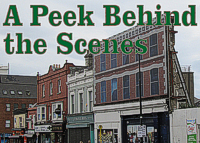
To answer the question, why is nothing happening on our web pages, the answer is, a lot has been happening - it's just mostly invisible, as we're repositioning our sites to last another fourteen years, at least. If nothing else, you might enjoy the opening illustration - a vinyl facade that is disguising rennovation work on a real storefront in Ireland, proof that there's even a prototype for the printed vinyl temporary storefronts on my own temporary railroads.
To see the article and lots of photos, please click the link below.
Here in Southwest Ohio, it's time to "deadhead" my Stubby Fingers and Blue Spruce sedum, and time to pull the crabgrass, nutgrass, and goldenrod that somehow gets seeded into my RR every year. Fortunately most other weeds slow down about this time of year.
Many people in the so-called temperate zones have Open Houses in September; if you're thinking about such a thing, now is the time to start planning. The Family Garden Trains Article "Open House Checklist" will give you some things to think about:
Plants in Mid-to-Late Summer: Although you're not supposed to plant trees in July and August, many stores start reducing prices on Dwarf Alberta Spruce and other landscaping trees about this time. Generally, if I pick anything like that up at the sales, I leave it in the pot in a mostly shaded area and make certain it stays moist until I have time to trim it up and get it into the ground in the fall. Here's a tip - one year I got a number of very small Dwarf Alberta Spruce cheap, but they were in a skinny little top-heavy pot and wouldn't stand up for me. I laid some concrete blocks on their side and dropped the pots into the openings, remembered to water once in a while, and the little trees did just fine, thank you. Eventually they did need to go in the ground, though.
Water Features in Mid-to-Late Summer: I also make certain that the "waterfalls" that aerate my pond are running properly. This includes cleaning out the filter as often as necessary to maintain a strong flow. I may have to treat the pond to get rid of that stringy dark algae (Pond Care Algae-Fix's present formula works without killing my plants, but be careful to read the label - some brands kill water hyacinth and other plants). If you do treat your pond for algae, make certain your pond is getting aerated - otherwise the dying algae can create an unhealthy environment for your fish.
Indoor Activities: If it's too hot to run trains, you might think about planning an indoor "test-track" somewhere that you can use in the "dog days" of August as well as the cold days of winter. It probably is time to start prioritizing your list of what you plan to get accomplished before the leaves fall. Unless you live where the leaves don't fall, then you REALLY need that indoor "test track."
Keep in Touch
As always, we have more articles in the works, and we are constantly updating our existing articles, so please check back often. Also, we are sharing some ideas and announcements on Facebook under the Family Garden Trains name.
Finally, please let us know about your ongoing projects. Ask questions, send corrections, suggest article ideas, send photos, whatever you think will help you or your fellow railroaders. In the meantime, enjoy your trains, and especially enjoy any time you have with your family in the coming weeks,
Paul Race
FamilyGardenTrains.com
To view the newsletter for December, 2011, click on the following link:
To read more, or to look at recommended Garden Railroading and Big Indoor Train products, please click on the index pages below.
|


|












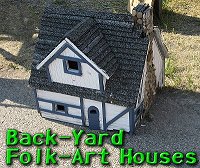 Backyard Folk-Art Houses
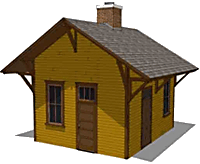 Free Station Plans from Garden Railways
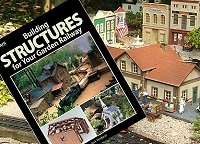 Building Buildings - Jack Verducci's Building Structures for Your Garden Railway
 Report: Planes, Trains, and Double-Deckers - Mass Transit and RR History in Dublin and London
 Report: Bray Station Mosaics
 A Peek Behind the Scenes