 | |||
 |
 |  | |
 |  | ||
 |  | ||
 |  | ||
 |  | ||
| |||
|
|
| | |
| | ||
| | ||
| | ||
| | ||




|
September, 2006 Update from Family Garden TrainsNote: This is an HTML version of an e-mail newsletter from the Family Garden Trains website, which publishes information about Garden Trains and related topics. If you would like to subscribe to the newsletter, please join our Mailing List, and specify that you want to receive e-mail updates.Fine Print: If you are receiving our e-mail updates and you no longer wish to subscribe, please e-mail me with a "Please Unsubscribe" message (worded any way you wish), and we will graciously remove you from our list. Topics discussed in this update include:
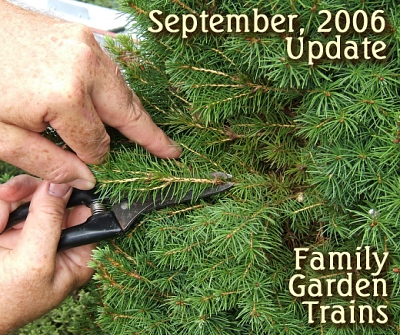
Big AnnouncementAnother free, professionally written article has been posted on the Family Garden Trains web site: Planning Your Garden Railroad for Operations. This article explains many ways to have fun running your trains the way that real railroads do. It's especially helpful to people who are just planning their railroads or who are planning their next expansion. The explanations and illustrations are sure to give you some great ideas, no matter what kind of railroad you have.We have also added a supplementary article, Introduction to Train and Car Cards, that discusses other ways many hobbyists add interest to their operating sessions. Within either article, you may click on any of the photographs or illustrations for a "blowup." In addition, each article includes links to other web pages and helpful resources that you can check out for more information. "Planning Your Garden Railroad for Operations" is one of a series of articles we've been working on since last August. More are planned, and some are in development now, so please stay tuned. Garden Railroading in SeptemberIn so-called temperate zones, September is often the best time of year to operate a garden railroad. Weed growth slows, algae growth in the pond slows, temperatures become reasonable, and generally the weather is a little more predictable. That said, it's also time to start preparing for cooler weather.Here in Southwest Ohio, it's time to "deadhead" most of my hostas (and other plants whose blooms have come and gone). Most hostas have a separate flower stalk, so I just cut that below the foilage line (I'll cut it the rest of the way down after frost has struck). My yarrows, big and small, are better off cut down to a few inches above the soil - they'll come back and fill in nicely between now and cold weather. Weeding-wise, I still have lots of crabgrass, nutgrass, and goldenrod to pull. Do not allow such nuisance plants to go to seed, or you'll be extra sorry next year about this time. Folks who use Preen say they don't have as big a problem, but my railroad would take a lot of Preen. Autumn Open Houses, AgainMany garden railroaders in the so-called temperate zones have Open Houses in September. Check your local club to see if they have any scheduled. You can do a search for local clubs on our Garden Railroad Club List page. Visiting other people's railroads will give you many great ideas, and you might come away with a few "starts" of plants you may find helpful.Planting in SeptemberIn the fall, stores continue to reduce prices on plants you may need. Virtually all plants that are commonly used in garden railroads can be planted in the fall. If you can "kid them along" until heavy frost (which mostly involves compensating for any periods of low rainfall) most of them will establish to some extent over the winter and have a "head start" next spring. This is especially true for thymes and sedums. See the Family Garden Trains article on Groundcover 101 for more information about thymes and sedums. For more ideas about perennials in general, see The Secret Life of Perennials.Trimming Trees and ShrubberyIf you have any trees or bushes that need trimmed, get started as soon as things start to cool down. Flowering plants such as forsythia, lilac, or vibirnum should be trimmed as soon as the flowers go off in the spring, so trimming them now will mean fewer flowers next spring, but if you have to trim them now, it shouldn't hurt the plant.Pay special attention to any dwarf conifers (such as Dwarf Alberta Spruce) that have grown up against each other or up against a wall. The warm, moist environment such crowding creates is especially inviting to spider mites and other tree-destroying vermin. Yes, it's hard to trim a Dwarf Alberta Spruce evenly all the way around the tree when it's in the ground, but you need to make the effort this fall, so the tree is ready to take advantage of late winter and early spring rains. Do NOT just trim the tree branches back wholesale, like the nurseries do. Each place you cut a branch will create two or more new sprouts in the spring. A nice, even trim, clipping off only the outside inch or so will result in such a crowd of new branches that your tree will have a nearly airtight "shell" that looks great by next July and may kill your plant by next October. The best thing you can do is "poke around" and "feel along" individual branches, to determine how far back you can cut and still leave nice soft needles on all parts that remain. I try to trim conifers at places that are junctions already. Often when two or more branches branch out from a junction, one grows way out and the other one is less "impressive." By consistently clipping off the branches that are longer and leaving the branches that are shorter, you can both "thin out" the excess growth and give the tree a narrower profile at the same time. Whatever you do, don't leave any partial branches that have no healthy growth left - those will die and rot out, making an inviting entry for a whole nuther set of tree parasites later. In other words, whenever you cut off a branch do it so that there is no bare "twig" sticking out, whether you cut it off at a junction or back at the trunk. The tree's bark will close over the cut much more quickly that way, improving both the health and the appearance of the tree. When you're all done with this careful pruning, you may go back and shape the tree from a more aesthetic viewpoint. Yes, it may look a little ragged for a few months, and you want to make certain to water enough to compensate for any autumn droughts. But by late spring, it will look "perkier" than ever, and you've probably added another two or more years to its lifespan. Some people buy a rooting solution and try making their trimmed bits into new trees. I'd like to try that this fall myself. No reason I can't put a bunch of 3" Dwarf Alberta Spruce or some such in the ground next year. I'll keep you posted. Water Features In SeptemberMaintain good water flow, especially as long as temperatures get over 75F during the day. Algae problems will start tapering off with the return of cooler weather. As leaves on water lillies and other pond plants start looking "sick," clip off and dispose of the ones you can reach. The pond and the rest of the plant will stay healthier.Start thinking about how you will protect your pond from leaves this fall. Nets made for this purpose are available at pond supply places. And when they're properly installed, they aren't even that noticeable. Don't put the net on until after you've taken care of your pond plants for the winter, though. See next month's newsletter for some hints about that. Yellow Jacket Alert Keep your eyes open. Yellow jackets and other paper wasps may fly a hundred yards to reach your pond and any remaining flowers, but if you see more than a few "hanging out" in any particular part of your garden, it's safer to assume there are more, maybe thousands more, within a foot or two of where you see them. Keep your eyes open. Yellow jackets and other paper wasps may fly a hundred yards to reach your pond and any remaining flowers, but if you see more than a few "hanging out" in any particular part of your garden, it's safer to assume there are more, maybe thousands more, within a foot or two of where you see them.
In the Midwest, Yellow jacket populations are at their peak. A single yellow jacket nest can produce thousands of onery wasps by fall, and they seem to get more and more touchy as cold weather approaches. Don't leave open Coke cans or other inviting sweet liquids around while you're working, and wear as many layers as you can stand while working near crowded vegetation you haven't disturbed for a while. If you start putting your buildings away before a few "killing frosts," be prepared to encounter some unwanted "house guests." (I've hurtled more than one building into the pond when I moved it and noticed a buzzing sound). You can find more information about yellow jackets and other safety issues in our article "Gardening Safety Tips." Indoor ActivitiesIn my part of the country, September is often the best time of the year to run trains, but if you do get rained into the house or otherwise stuck inside, this is a good time to start thinking about winter projects. If you don't have a "test" track (say around the upper wall of your basement) where you can run trains this winter, this may be a good time to start planning one. Are there any kits you'd like to order so you have them on hand once it's too cold to work outside? Is it time to start putting together your Christmas list?Above all else, enjoy your trains, and especially enjoy any time you have with your family in the coming weeks, Best of luck, Paul Race To see the newsletter for August, 2006, click here. To see a special announcement about LGB that was issued on September 22, 2006, click here. To see the newsletter for October, 2006, click here.
|

| 
|
 |
 |
|  |  |
Note: Family Garden Trains?, Garden Train Store?, Big Christmas Trains?, BIG Indoor Trains?, and BIG Train Store? are trademarks of Breakthrough Communications (www.btcomm.com). All information, data, text, and illustrations on this web site are Copyright (c) 1999, 2000, 2001, 2002, 2003, 2004, 2005, 2006, 2007, 2008, 2009, 2010, 2011, 2012 by Paul D. Race. Reuse or republication without prior written permission is specifically
forbidden.
Family Garden Trains is a participant in the Amazon Services LLC Associates Program, an affiliate advertising program designed to provide a means for sites to earn advertising fees by advertising and linking to amazon.com.
For more information, please contact us
