| |||
 |
 |  | |
 |  | ||
 |  | ||
 |  | ||
 |  | ||
| |||
|
|
| | |
| | ||
| | ||
| | ||
| | ||




|
October, 2006 Update from Family Garden TrainsNote: This is an HTML version of an e-mail newsletter from the Family Garden Trains website, which publishes information about Garden Trains and related topics. If you would like to subscribe to the newsletter, please join our Mailing List, and specify that you want to receive e-mail updates.Fine Print: If you are receiving our e-mail updates and you no longer wish to subscribe, please e-mail me with a "Please Unsubscribe" message (worded any way you wish), and we will graciously remove you from our list. Topics discussed in this update include:
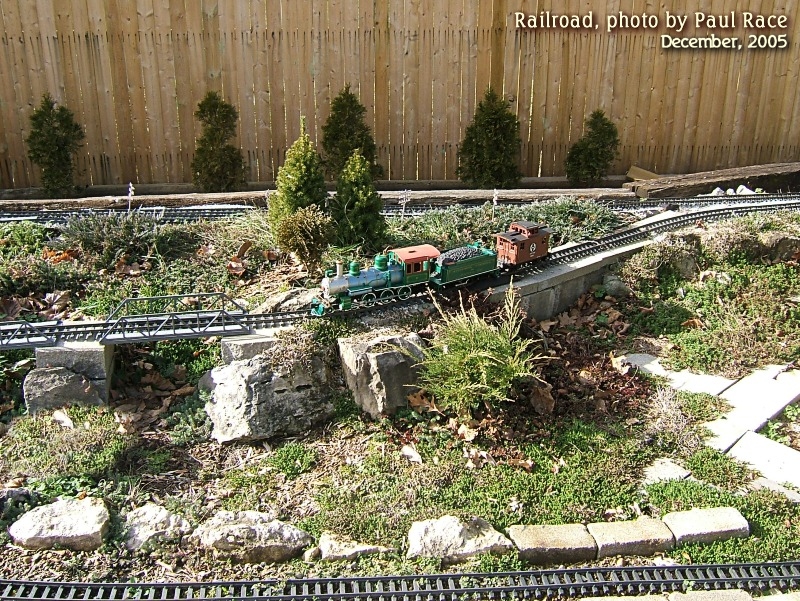
Garden Railroading in OctoberIn so-called temperate zones, October brings shorter days, cooler temperatures, and the beginning of the annual falling leaf crisis. Weed growth should be non-existent, and most remaining gardening tasks can slide a week or three if they need to. So if you've been putting off a big, sweaty job, this may be the best month to do it, when you can start the job with a windbreaker and take it off as the day warms up.The first heavy frost signifies that it's time to cut back perennials that will soon be freezing off at the ground anyway, including Hostas and Sweet Woodruff. On the other hand, a warm, damp October will still allow goldenrod, ragweed, thistle, or dandelions to pop up "out of nowhere," so keep your dandelion digging tool near the garden for a few more weeks (I keep one in an engine house where I can reach it in a hurry and avoid the temptation to pull the leaves off a plant and leave the root). Planting in OctoberSome stores like to bring in trees, especially evergreens, with the idea that it's better to plant certain varieties in the fall. This is only true if you monitor the condition of the plant and make certain it has enough water until several frosts have come. Other plants may be closed out at very low prices or even discarded. Except for dwarf and low-lying conifers, which you can almost always use somewhere, don't buy a bunch of plants you don't really know what to do with. I also keep my eye out for Tom Thumb Cottoneaster, which seems to survive a fall planting well, and makes a nice miniature fruit tree when trimmed properly. Sedum tips that are poked into the ground in the fall may establish and even spread a little by spring if the winter is fairly mild. See the Family Garden Trains article on Inexpensive and Low-Maintenance Plants for Garden Railroads for more information about propagating sedums and other useful groundcovers.Sometime between now and Thanksgiving, get any spring-blooming bulbs into the ground. Crocus and Grape Hyacinth provide great early spring color in plants that are small enough to keep from overwhelming your trains. For more ideas about fall bulbs, see Early Spring Color for your Garden Railroad. Note: If you acquire a dwarf or low-lying conifer that needs trimming before it goes into the ground "permanently," place it somewhere where it will get shade and rain until you get to it. If you realize later that you're not going to get to it before the weather turns too cold, plant it in the ground pot and all, dash some water on it, and monitor its condition until you start getting multiple frosts in a row. The September Update contains some information on the mechanics of trimming dwarf conifers to improve their health and appearance. Cutting Back PlantsAs mentioned before, once frosts start hitting, you might as well cut down any plants that freeze off to the ground anyway, such as Hosta, Baptisa, Sweet Woodruff, Coreopsis. Consider cutting back (not down) plants that don't freeze back entirely, such as thyme, sedum, finger geranium (cranesbill), and lavender. Leave a few inches with foilage if you can (that may be impossible with thyme you've let get too long), but trimming them back now (or later in the winter) will help their growth next spring to be more compact and healthy-looking. Yes, it is possible to throw any patch of thyme into fatal or near-fatal shock by overtrimming, but in the case of overgrown "vulgaris" (common) thyme, you may have to weigh that risk against the liklihood of having 12-inch plants with only 3 inches of foilage at the end by next spring.Water Features In OctoberOnce you've had a frost or two, you need to start getting your water plants ready for winter. I like to use non-rusting scissors to clip off and discard any remaining leaves from my water lilies (if you can't reach them all, that's okay, get what you can - you'll improve the health of your pond this winter if you keep them from staying and decaying). Most pond plants that protrude above the water should be trimmed back to the water line (although you may own a plant or two that are exceptions - refer to your supplier for specifics). If you have "shallow-water" plants in containers on shelves, you probably want to drop the containers into deep water for the winter - just remember to fish them out and put them back where they belong next spring. In my case, I have pickerel rushes in containers on a "shallow-water" shelf. I trim the rushes back to an inch or so above the soil line, then drop their pots into the deep center of the pond.
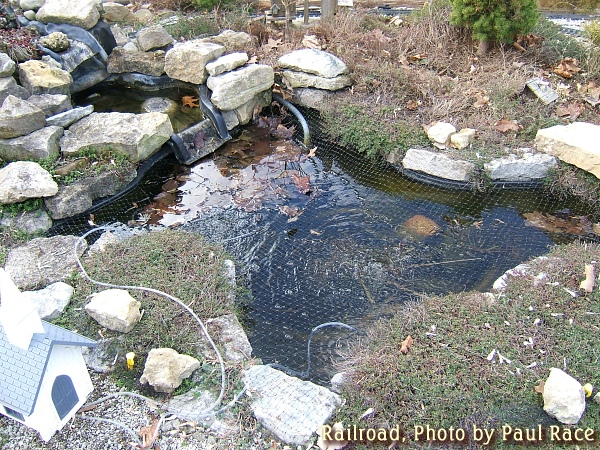
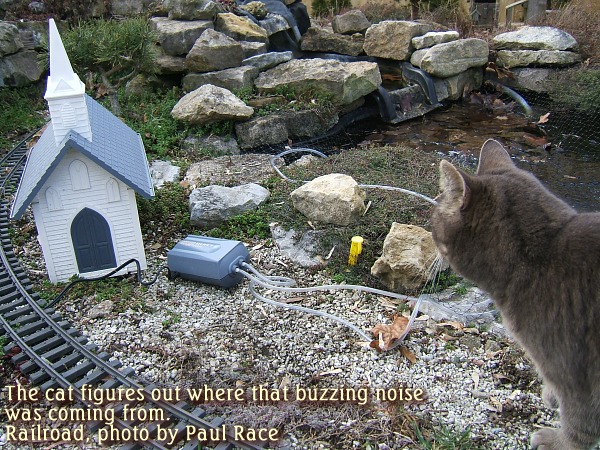
If your pond is too big to stretch a net across, do what you can and take comfort in the fact that the larger the pond the less damage to the water chemistry will be done by any individual leaves that do get through. If your pond, like mine, is small enough to easily spread a net across, then by all means do so. How long do you leave the net on? Some folks leave it on only until all the leaves in their yard have fallen and are raked. But my neighbors don't rake, and dry leaves that have blown like tumbleweeds from a half a mile away are still hitting the water and sticking like flies to flypaper as late as April. Still, I generally get "excited" about spring and take my pond netting off in March. The point is to reduce the amount of plant material that decays in the pond as much as you reasonably can, without diminishing your enjoyment. It's also time to start thinking about how you will protect your fish from oxygen deprivation during the winter. In my part of the country, they say that goldfish will survive the worst winters in a 2-foot-deep pond as long as they have oxygen (for koi, they recommend 3' - check with your local pond supply for details about your area). Freezing solid into the ice doesn't hurt goldfish as much as you think it might. But a buildup of carbon dioxide and or a shortage of oxygen in the water can kill your fish even in a pond that only freezes a couple of inches deep and stays that way for a while.
Indoor ActivitiesIf you have any good weather in October, make use of it. But if you get stuck indoors, it's time to finalize your Christmas list. Also if you buy (or have bought) any kits that you plan to assemble, this is a good time to clean up the flash and paint them (especially if you like to do your spray painting in a garage, porch or other non-heated area). For more information about painting plastic structures, check out our article on the subject.Finally, if you're thinking about any extensions or changes to your railroad, this is a good time to start drawing up plans and calculating budgets. Our article on Building a Garden Railroad on a Budget should give you some ideas about how to budget your next expansion. Above all else, enjoy your trains, and especially enjoy any time you have with your family in the coming weeks, Best of luck, Paul Race To view the newsletter for September, 2006, click here. To view the September 22, 2006 special report about changes at LGB(r), click here.
|

| 
|
 |
 |
|  |  |
Note: Family Garden Trains?, Garden Train Store?, Big Christmas Trains?, BIG Indoor Trains?, and BIG Train Store? are trademarks of Breakthrough Communications (www.btcomm.com). All information, data, text, and illustrations on this web site are Copyright (c) 1999, 2000, 2001, 2002, 2003, 2004, 2005, 2006, 2007, 2008, 2009, 2010, 2011, 2012 by Paul D. Race. Reuse or republication without prior written permission is specifically
forbidden.
Family Garden Trains is a participant in the Amazon Services LLC Associates Program, an affiliate advertising program designed to provide a means for sites to earn advertising fees by advertising and linking to amazon.com.
For more information, please contact us