| |||
 |
 |  | |
 |  | ||
 |  | ||
 |  | ||
 |  | ||
| |||
|
| | |
| | ||
| | ||
| | ||
| | ||
Written by Paul D. Race for Family Garden Trains(tm)
 |
|
|
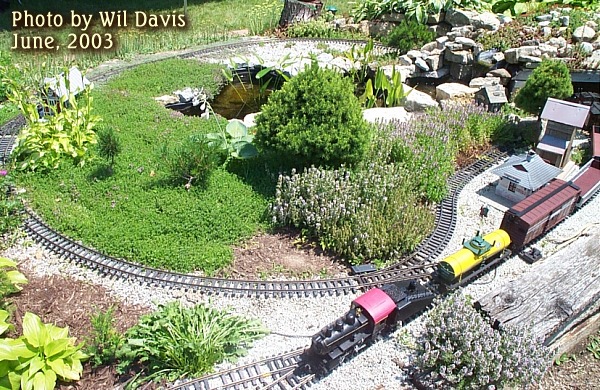
Avoiding ShortcutsSeventeen years after breaking ground on our first "permanent" garden railroad, I have a long list of things never to do again. First on that list is setting my original right-of-way on a gravel-filled trench, the method espoused by all of the most popular and qualified garden railroad writers of the 1990s, and a method that only works long-term if you live where there's less than thirty inches of rain a year (where those guys all lived). Another is using railroad ties to build a retaining wall. These are doomed to eventual failure in Ohio, no matter how careful you are about drainage. That said, both of those may work for you, depending on where you live, but I chose both approaches because they seemed to be less work than some of the other things folks were doing, and I was in a hurry to get trains running. And I lived to regret them.I wasn't alone. The sad truth is that many garden railroads last less than ten years, because the materials, methods, and even the designs used are doomed to fail or to create maintenance nightmares within a few years. You don't hear more about it because many folks take up the hobby when they retire, and by the time massive failures start, they're ready to downsize in a number of ways anyway. The sad part is when folks who are still in good health and could have kept operating for years longer have to "pull the plug" on their railroad because the maintenance load has been increasing every year and they just can't keep up. If you're thirty, and planning to move before you retire, do whatever you want. For the rest of us, a little more attention to long-term maintenance issues will help. What Works Where You Live?If you haven't started your garden railroad yet, one of the best things you can do is to try to find any garden railroad older than eight years in your region, and go see what they did right. Or if they're at the point that some people reach, where they spend a minimum of two hours a day just in maintenance activities, find out what they would do differently next time. The reason I mention your region is that folks in some parts of the country can get away with some things you'd never get away with where you live, and vice versa. The reason I mention railroads older than eight years is that almost every garden railroad looks great the first four years or so it is in existence. The photo at the top of the page was taken four years after I broke ground, during an open house for the the 2003 Garden Railway convention in Cincinnati, Ohio. Beautiful, right? Visitors thought I had it all together. But to get it back to that kind of appearance today would require almost a complete overhaul. You want to see railroads that have stood the test of time. Paint Your Buildings ProperlyNo matter where you live, plastic fades and turns brittle eventually, even so-called UV-resistant plastic. For that reason, all buildings should be primed and painted with indoor-outdoor paint before they are set out. I have had paint failure on a few of the buildings I painted sixteen years ago and left out in all kinds of weather, but I haven't had plastic failure or structural deterioration in any plastic parts on any of them. In the meantime, I've seen many unpainted "UV-resistant" buildings from companies like Pola and Piko change color and even break down after five or six years of direct sunlight. For more information on that topic, check out our Painting Plastic Structures article. In addition, make provision for bringing your buildings in or otherwise protecting them from the weather during the "off season." My buildings can go much, much longer between paintings and touch-ups that way. (And since I painted them properly in the first place, I talking about every 20 years instead of every 10, give or take.) By the way, a fellow club member cleans her buildings annually, then sprays them with a UV-resistant flat or satin-finish spray acrylic. (Flat is better, but it's harder to find cheap.) She swears this helps keep them from deteriorating and I have no reason to doubt her. So if you've already put your buildings together without painting them properly first, consider this precaution. While I'm on the subject, spraying your figures annually with a flat or satin UV-resistant acrylic will also help preserve them. I usually only leave my figures out a few weeks a year, so I haven't noticed any serious deterioration yet, but if you leave them out in direct sun for months on end, consider this precaution. Build a Weed-Proof, Bug-Proof, and Frost-Heave-Proof Right-Of-WayIt's one thing to have to weed so your railroad looks good. It's another to have to spend hours weeding every time you want to run trains. In addition, some of the things you can do to keep your railroad from being overtaken by weeds will also help keep it being knocked akilter by frost heave. That said, some things that work in Ohio won't work in California or Canada, so these are just suggestions - find out what folks in your region have tried successfully long-termRaised Railroad Option If you live where there is no frost line to speak of or the frost line is less than three feet, you might consider a raised railroad on pressure-treated posts sunk below the frost line. The most common solution is 2"x6" pressure-treated wood, which is often used in raised railroads. Many garden railroaders then backfill with dirt to provide a base for landscaping, etc., but use gravel under and around the 2"x6" lumber to provide drainage. You don't want your 2"x6"s standing in water or laying in soil that is constantly moist - they're not made for that. If you live in the American southwest, you might be better off using plastic or composite lumber, as long as it's supported along its entire length. The bugs shouldn't eat it, but it has been known to sag between supports in very hot locations. In Ohio, the "frost line" is about 24" deep. If I want to build a raised railroad that survives bitterly cold winters, I need to sink my posts or risers 24" into the ground. This isn't a joke or me making more work for you. Yes, I've dug many holes manually, but I recently checked, and if I ever want to drill a lot of post holes at a time, I can rent a 1- or 2-person gasoline-powered post-hole digger for less than $100 a day. The 4"x4" pressure-treated posts I get around here are ground-rated, and so far I've had no problems. I haven't had any problems with 2"x6" right-of-way supports (sometimes called "stringers") either, but I don't have them sitting directly in the soil. Please note that the frost line measurement - wherever you live - is for undisturbed soil. A few years ago a friend in the region thought he could avoid drilling holes in the ground by bracing his 4"x4" posts in place on top of the existing soil and backfilling two to four feet of dirt around them. That first summer he enjoyed the daylights out of his railroad and gloated about finding a shortcut that none of us idiots had thought of. But of course, backfilled dirt takes years to settle, and the frost line was still exactly where it had always been. The next spring, the right of way looked like a roller-coaster designed by a drunkard, because every post had risen and fallen again, just not at the same rate. Sadly, he was so frustrated he gave up on the hobby right then and nothing we could say, nor any help we could offer would change his mind. Floating Railroad Option This won't work in parts of the American Southwest where termites and other wood-eating insects routinely devour pressure-treated wood regardless of what the tag on the end says. But if you live where the frost line is too far down to bother digging, or you just don't mind a ground railroad, consider a "floating roadbed," 2"x6"s fastened together with extra-long bracing so that the whole thing rises and falls as one unit. In places with serious frost heave, the whole railroad will go up and down at the same time. In places without frost heave, it will stay put with gravity - though you'll want to be sure it has plenty of drainage in wet climates. Sure, in the spring, you may have to chock or shim places to level them out, but you won't have to weed the ROW or - worse yet - rebuild your railroad every year.
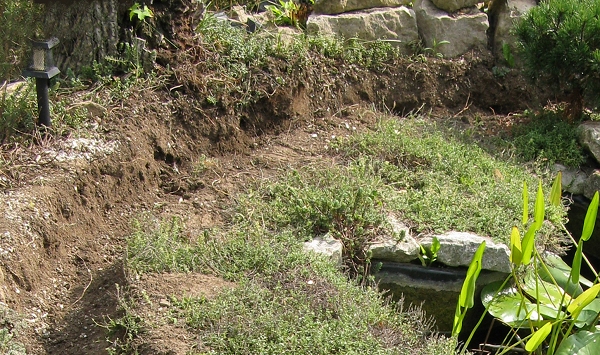
I tried this technique as a "retrofit" after my "gravel-in-a-trench" ROW failed completely, thanks mostly to weeds and critters. I used the special "non-cracking" concrete mix (Quickrete Crack Resistant Concrete Mix, No. 1006-80). It has a bunch of little plastic threads embedded to add strength. I especially recommend this if you live where there is frost heave - it will crack much less than standard concrete.
The photo to the right shows the concrete poured in and mostly leveled. Since the mountain and other obstructions kept me from using typical leveling techniques, I put the track in place temporarily and checked its level. Then I swept the concrete mix down to the top of the ties, removed the track and lightly sprinkled the concrete until it was saturated. If I'd done this when I first built that section of railroad, it would have taken me about thirty more hours to install that section than it did. But it would have saved me about 1000 hours of weeding and track re-leveling over the lifetime of the railroad. BTW, when I put the track back, I did use turkey grit ballast to level and dress it, so it wasn't just sitting on concrete. Three years later, it has survived three wild, cold, and wet winters since with only minor breaking up in places where I couldn't the trench as big or deep as I wanted. If I start a new railroad with this kind of construction, I'll make sure the trench's width is at least 6" (8" is better) and try to keep the depth about 8". Also, I'll pour the concrete in mixed, which should let it set up much more evenly. A Note About Ladder Roadbed - Many railroaders have achieved beautiful smooth curves using architect Bill Logan's "ladder" technique (as described here). But by its very nature, it has gaps that weeds can grow through. If the roadbed is completely elevated, say on a trestle, that's not a problem. However, if you backfill so that there is soil under the roadbed (or even in the gaps), weeds may be a problem, especially in humid climates. Consider cutting strips of heavy UV-resistant black plastic (the kind used for landscaping) or some such to lay under roadbed, or even on top of it. Limit Places Weeds Can GrowSome time back Marc Horowitz, editor of Garden Railways published an article about pouring concrete "aprons" where you're going to set your buildings. Marc was thinking mostly about giving the buildings a good foundation. But here's a thought - if you're going to have a large downtown section or other scene where plants will be few, consider pouring a concrete base for them. If you want to leave spaces for plants you can, using cardboard tube or flowerpots or whatever to create a "hole" in the finished base. If you know where your buildings are going, you can feed the wires for them through before you pour the concrete as well. But this will keep dandelions from growing up between your structures or worse yet, through them.Some of my friends out west use the Bob Treat rock and cliff method. Instead of piling dirt high and building retaining walls to contain it, they use a wood and wire framework to create hollow mountains similar to the chicken-wire-and-plaster mountains we used to build for our indoor railroads. Where they want plants, they embed plastic flower pots or some such into the framework. Of course they'll also have to pay attention to watering, since their plants' roots will never reach the actual ground. But the results can be spectacular. In fact, I think I may try something like this for at least part of my next railroad. Keep All Track Within ReachThis is especially critical for turnouts (switches), which are more likely to cause derailments than almost anything else besides tree debris falling on the track. Tunnels you have to lay down to reach into are another no-no.Provide Easy Access to the Entire RailroadYes, this is hard when you're working in a medium where 10'-diameter curves are often considered the minimum for good operation. But if you wind up reaching more than 24" to do anything on a regular basis (change light-bulbs, retrieve fallen figures, clean track, weed, etc.), the time will come when it just becomes too hard. Again, I prefer raised railroads for any number of reasons, but even if you provide a walkway through a ground-level railroad (disguised as a road or some such), there is nothing easy about bending over or going to your knees constantly for minor maintenance.Avoid "Tight Squeezes."When I built the New Boston and Donnels Creek Rail Road, I thought I was leaving plenty of room to work around it. But as trees I planted near and on my railroad grew, I found myself increasingly working around them, crouching over or squeezing into tight places to do maintenance. Visually, the effect was stunning. But backing out of a tight corner with a fist-full of weeds and a kinked back isn't as much fun as it used to be. In one case, I had to remove a very attractive tree that was just plain crowding me out.The next railroad is going to have 48" paths all around. 36" would probably be sufficient, but why not account for, say, wheelchair traffic as well?
Our article Planning Your Garden Railroad for High Reliability" has some hints about avoiding S curves and other issues that can make ordinary running troublesome.
|





|
Note: Family Garden Trains?, Garden Train Store?, Big Christmas Trains?, BIG Indoor Trains?, and BIG Train Store? are trademarks of
Breakthrough Communications (www.btcomm.com). All information, data, text, and illustrations on this web site are
Copyright (c) 1999, 2000, 2001, 2002, 2003, 2004, 2005, 2006, 2007, 2008, 2009, 2010, 2011, 2012, 2013, 2014, 2015 by
Paul D. Race. Reuse or republication without prior written permission is specifically
forbidden.
Family Garden Trains is a participant in the Amazon Services LLC Associates Program, an affiliate advertising program designed to provide a means for sites to earn advertising fees by advertising and linking to amazon.com.
For more information, please contact us
 |  |
| Visit related pages and affiliated sites: | |||||
| - Trains and Hobbies - | |||||
|  |
|
 |
|  |
 |

|

|  |
|

|
| - Christmas Memories and Collectibles - | |||||
 |

|
 |

|
 |

|
| - Family Activities and Crafts - | |||||
 |

|

|

|

|

|
| - Music - | |||||

|
 |
 |

|

|

|

|

|

|

|

|

|

|

|

|

|

|

|