 | |||
 |
 |  | |
 |  | ||
 |  | ||
 |  | ||
 |  | ||
| |||
|
|
| | |
| | ||
| | ||
| | ||
| | ||






|
November, 2006 Update from Family Garden TrainsNote: This is an HTML version of an e-mail newsletter from the Family Garden Trains website, which publishes information about Garden Trains and related topics. If you would like to subscribe to the newsletter, please join our Mailing List, and specify that you want to receive e-mail updates.Fine Print: If you are receiving our e-mail updates and you no longer wish to subscribe, please e-mail me with a "Please Unsubscribe" message (worded any way you wish), and we will graciously remove you from our list. Topics discussed in this update include:
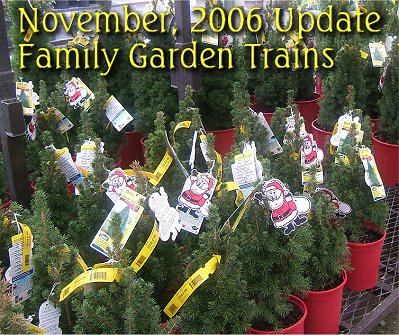
Special Announcement - New Article: Trees for Your TrainsFamily Garden Trains is proud to announce another in its series of "definitive" articles on topics that are important to Garden Railroaders. "Trees for Your Trains - Choosing and Cultivating Dwarf Conifers" tells you just about everything you need to know to populate your railroad with evergreen shrubs that look just like little trees and require relatively little maintenance once you've got them off to a good start. Click on the following link for more information. http://familygardentrains.com/primer/plants/conifers/conifers.htmGarden Railroading in NovemberWell, daylight savings time is a thing of the past, so for many of us it will be dark when we get home. That means that most of the work we do on our railroads will happen on the weekends. This year they're predicting a fairly mild winter in the so-called temperate zones, and if you got that big freeze in mid-October, most of the leaves should be down. So if you've stayed caught up, most of your raking should be done for the year. Also, most of your plants that freeze off at the ground should be done for. So if you haven't already cut off your hostas, sweet woodruff, and such, you should be able to pull what's left right off at the ground. Your sedums will start to fade in color -some even change color. They also may even appear to shrink a little as they go into "winter dormant" mode. However, their roots continue to spread during warm spells all winter long, so they should come back better than ever in the spring. If you have sedums that get several inches tall, like Blue Spruce sedum, you can cut them back now within a couple inches of the soil without hurting them at all.If you need to prune any trees or bushes, this is a great time to do it - even your evergreens are semi-dormant, and pruning is less likely to bother them than it does during warmer temperatures. On my railroad, I've added plenty of evergreens, so that most of the railroad is at least some shade of green all winter long. You may also have leftover tasks from October (getting your pond ready, etc.) If you've misplaced your link to our October newsletter, it's at the bottom of this newsletter. In my case, I was out of town both weekends that we had decent weather, so my pond has still not been prepared for winter and at the moment it is full of leaves. :-( What About Living Christmas Trees?You may still have some things you thought about planting this fall (such as any bulbs or shrubs you've already purchased and haven't gotten into the ground yet). In addition, you may be tempted by little Christmas-tree looking conifers being sold in the store.
So, how do you give these things a chance at survival? Again, I hinted at it earlier. Once ANY tree has been subjected to a heavy frost or two, it starts to go dormant - even evergreens. Think of it as a sort of "hibernation." If you take ANY living thing that has been "hibernating" outdoors in freezing temperatures, then plop it into a warm living room, you'll put it into a shock from which it may not recover. That's why the directions for the big ($75-200) "Living Christmas Trees" tell you to spend two weeks gradually acclimating the tree to warmer temperatures. Then they tell you to leave the tree indoors for no more than three days. (The dry air in a heated house also stresses the plant, even if you keep the roots moist.) Finally, the instructions tell you to spend another two weeks gradually acclimating the tree to cooler temperatures before you stick it into the ground. This lets the tree start to go dormant again so it doesn't go into shock when it's exposed to very cold temperatures. This CAN be done. Some people do it every year. But if someone gave me $200 and told me I needed to spend it on a "Living Christmas Tree," I'd seriously consider spending $50 on a cut tree and spending the other $150 on a live tree to plant right into the ground - a year from now I'd still have the $150 tree at any rate, and if I didn't, at least I'd have a warranty on it, which you don't usually get on trees you use in your house. That said, the little Dwarf Alberta Spruce I saw at Lowes have a much shorter list of instructions, and I believe, a greater chance of survival, if you want to go that route. The instructions seem tailor-made for climates where it doesn't get REALLY cold Of course, as a garden railroader, I'd probably be tempted to trim the poor things up before I put them into the ground. (See my primer article on "Trees for your Trains" for more information about that.) But that might be "pushing it" on trees that have already been stressed by using indoors and planting midwinter. About Big Christmas Trains(tm)Near the top of the HTML page for this newsletter, you'll see a little picture ad for "http://BigChristmasTrains.com." In the interests of full disclosure, I'll explain that the "Big Christmas Trains" site happened because, in October of 2004, a vendor asked me to list some train products on my web site and we thought we'd try it. We don't actually stock or sell any trains, we just provide links to the vendors, but the vendors kick a little back our way when they sell a train. The Big Christmas Trains (O scale and larger) have actually been a bigger hit than anyone would have expected, so the vendors have added new trains to their sites, and we've added new links to those trains. No, it didn't/doesn't make us rich, but it does help pay the bills we rack up keeping Family Garden Trains online.We also receive some support from the Garden Train Store pages, in case you wondered, but at this time of year they don't generate as much traffic as the Big Christmas Trains(tm) pages. LGB UpdateAccording to a source at LGBoA, a new agreement has been negotiated between LGBoA (the people who market LGB trains in North America) and Dr. Goede, the fellow who's administrating the company that makes LGB during its bankruptcy proceedings. The new agreement should mean lots of LGB trains coming to America, including one shipment that is in the Port of New York right now. So the trains are continuing to run. If you missed the history of all of this, the following links will get you caught up:
2006 Garden Railroading Bargain of the YearOn November 1, I will be putting up a seasonal "blog" that will describe a supurb bargain that will give you some Christmas present ideas and winter project ideas at the same time. The short story is that the Colorado Model Structures company can sell you a whole town's worth of buildings for what you'd usually pay for just one. Yes, you have to paint them yourself, but I always recommend that anyway. These make good Christmas presents and good "winter projects" both. Unlike the Big Christmas Trains(tm) stuff, I don't receive one penny for promoting this company or its products, but I appreciate their drive to make the hobby affordable for as many people as possible. For a sneak preview about the 2006 Garden Railroading Bargain of the Year, click on the following link:http://familygardentrains.com/blog_like_content/06_11_blogs/06_11_01.htm Indoor ActivitiesBy now most garden railroaders in places that get cold weather have put up most of their trains and accessories for the rest of the winter. But some folks keep their hobby going with winter projects. Of course, getting trains ready for your Christmas tree or building a Christmas village is a lot of fun. So is setting up a Christmas village and train for your church, workplace, or community organization. But beyond that, you might consider:
Of course there are as many different kinds of winter projects as there are garden railroaders. Above all else, enjoy your trains, and especially enjoy any time you have with your family in the coming weeks, Best of luck, Paul Race To view the newsletter for October, 2006, click on the following link: http://familygardentrains.com/fgt_newsletter/06_10_newsletter.htm
|

| 
|
 |
 |
|  |  |
Note: Family Garden Trains?, Garden Train Store?, Big Christmas Trains?, BIG Indoor Trains?, and BIG Train Store? are trademarks of Breakthrough Communications (www.btcomm.com). All information, data, text, and illustrations on this web site are Copyright (c) 1999, 2000, 2001, 2002, 2003, 2004, 2005, 2006, 2007, 2008, 2009, 2010, 2011, 2012 by Paul D. Race. Reuse or republication without prior written permission is specifically
forbidden.
Family Garden Trains is a participant in the Amazon Services LLC Associates Program, an affiliate advertising program designed to provide a means for sites to earn advertising fees by advertising and linking to amazon.com.
For more information, please contact us

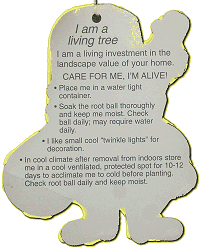 until after Christmas; they assume that the tree hasn't gone dormant before you bring it inside. You can't make that assumption, but you probably CAN find a microclimate somewhere on your grounds that will protect them from sub-freezing temperatures for a few weeks without exposing them directly to heated indoor air. If that is a place where they will get at least some light, there's no reason not to buy the little tree(s) now, so you have some control over what its/their exposure between now and Christmas. This way, you can spare the tree(s) the shock of being allowed to go dormant, then being forced out of and back into dormancy (is that a word?) within a six or eight week period. Be sure to keep them moist. If you want to set them outside on sunny days with mild temperatures, by all means do so. Just bring them in before the temperature drops below 40F or so. Because these trees haven't had a chance to go dormant, they will not be quite so "touchy" about a few days' exposure to heated indoor air. Keeping them watered is a must, though. Then, when the holidays are over, the rest of the process is the same - you move the trees gradually into progressively cooler temperatures until it is safe for them to go into the ground. When you plant them, though, do all the nice things for them you're supposed to do, including providing good planting soil and water.